Here is all the information you need to start planning, designing, operating and maintaining your reservoir
Farm reservoirs: From optional to essential
Many parts of England, and particularly in the eastern counties, are facing growing pressure on agricultural water supplies, with droughts, abstraction restrictions and environmental targets reshaping future irrigation. Farm reservoirs are increasingly becoming essential infrastructure for business resilience — allowing growers to capture winter water, reduce dependence on summer abstraction and protect high-value crop production.
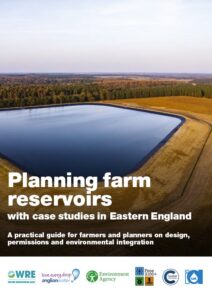
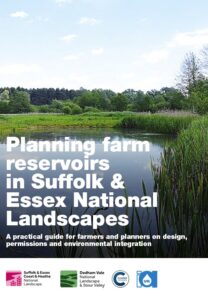
New practical farmer-focused reservoir guides have now been produced with support from Water Resources East and the Suffolk & Essex Coast & Heaths and Dedham Vale National Landscapes. The guides cover planning, permissions, design, environmental integration, costs and collaboration, supported by real farm case studies from across Eastern England.
Click on the booklets to download
Useful links for more information related to farm reservoirs
Assessing the renewable energy, water resources and environmental benefits of floating solar on farm reservoirs
Deploying floating solar on farm reservoirs has potential to transform the economic viability of reservoir construction (providing resilience and business growth benefits), reducing energy costs and GHG emissions (Net Zero benefits). Supported by case studies, this booklet provides farm businesses and their advisers with guidance to help them understand the concept of FPV, the potential benefits and trade-offs, and how floating solar can be successfully integrated into farm reservoir design and management.
Click on the booklet to download
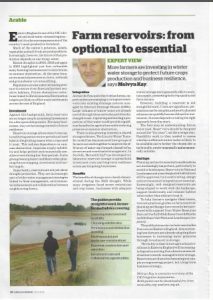
Article on reservoirs in Anglia Farmer summer 2026
A review of the booklets on farm reservoirs
Click on article to download
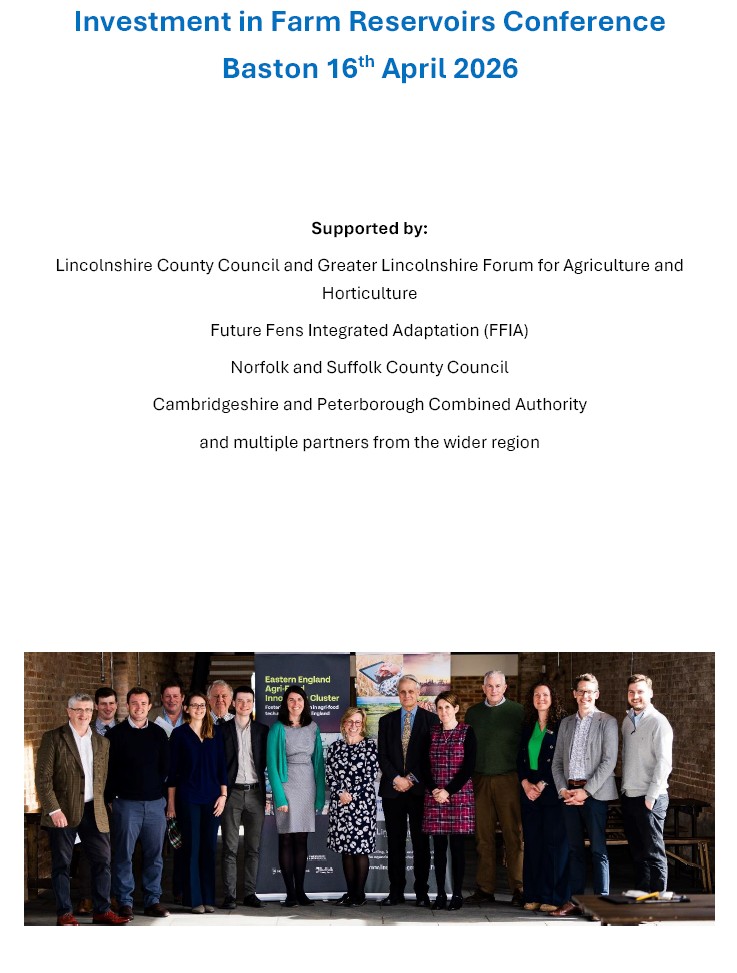
Investment in farm reservoirs conference Baston April 2026
Over 60 farmers and representatives of regional and national organisations who support the industry met to debate how the farming industry can use on-farm reservoirs to capture and store more peak flow or flood water. The development of on-farm reservoirs aims to: secure water supplies for agriculture; reduce flood risk; increase water storage across the landscape to benefit biodiversity; and reduce potentially harmful abstraction at low flow. Click on the report to download